




Global Mobility Built for Better Outcomes

You have mobility needs, we orchestrate global solutions. NEI helps you get the results you seek and the experience your employees deserve.

Portrait of a relocation client
Reviewing relocation paperwork and data
NEI team members meeting with a client
Man checking his phone during a relocation
Woman unpacking a moving box in her new home
Family enjoying their new home after relocating

What matters most to your program?

Enterprise organizations reduce time to deployment, cut relocation spend, and strengthen assignment outcomes. These numbers reflect what happens when technology, expertise, and partnerships work together.

40%

Move talent faster

Reduction in time to market entry and assignment start

Learn More >

99%

Strengthen compliance

Immigration and tax compliance rate across all assignments

Learn More >

35%

Reduce program costs

Decrease in relocation spend through vendor consolidation

Learn More >

92%

Improve assignment success

Employee retention and assignment completion rate

Learn More >

Trusted by Fortune 500 Enterprises Globally

“Our company went through a large-scale employee relocation across multiple states, and the team made the entire process feel seamless. I’ve worked with several mobility providers over the years, and this was by far the smoothest experience we’ve had.”

— Sarah M., HR Director

“Our company went through a large-scale employee relocation across multiple states, and the team made the entire process feel seamless. I’ve worked with several mobility providers over the years, and this was by far the smoothest experience we’ve had.”

— Sarah M., HR Director

“Our company went through a large-scale employee relocation across multiple states, and the team made the entire process feel seamless. I’ve worked with several mobility providers over the years, and this was by far the smoothest experience we’ve had.”

— Sarah M., HR Director

“Our company went through a large-scale employee relocation across multiple states, and the team made the entire process feel seamless. I’ve worked with several mobility providers over the years, and this was by far the smoothest experience we’ve had.”

— Sarah M., HR Director

“Our company went through a large-scale employee relocation across multiple states, and the team made the entire process feel seamless. I’ve worked with several mobility providers over the years, and this was by far the smoothest experience we’ve had.”

— Sarah M., HR Director

“Our company went through a large-scale employee relocation across multiple states, and the team made the entire process feel seamless. I’ve worked with several mobility providers over the years, and this was by far the smoothest experience we’ve had.”

— Sarah M., HR Director

“Our company went through a large-scale employee relocation across multiple states, and the team made the entire process feel seamless. I’ve worked with several mobility providers over the years, and this was by far the smoothest experience we’ve had.”

— Sarah M., HR Director

“Our company went through a large-scale employee relocation across multiple states, and the team made the entire process feel seamless. I’ve worked with several mobility providers over the years, and this was by far the smoothest experience we’ve had.”

— Sarah M., HR Director

“Our company went through a large-scale employee relocation across multiple states, and the team made the entire process feel seamless. I’ve worked with several mobility providers over the years, and this was by far the smoothest experience we’ve had.”

— Sarah M., HR Director

Where We Specialize

Different industries face different mobility pressures. We’ve built deep
expertise across manufacturing, life sciences, energy, and finance to
understand what drives your assignments and what can derail them.

Manufacturing professionals coordinating production operations
Manufacturing

Move production teams and operations leaders globally

Manufacturing expansions and facility relocations demand precision timing and coordination across multiple countries. NEI manages the complexity of moving technical talent, securing compliance across jurisdictions, and keeping operations on schedule while your people settle.

Why NEI


Life sciences professionals collaborating with an employee
Life Sciences

Move critical talent without slowing innovation

From research teams to specialized leadership, life sciences mobility requires speed, compliance, and care. NEI coordinates the details so employees can transition confidently while your organization protects continuity and momentum.

Why NEI
Digital network representing finance and insurance mobility
Finance & Insurance

Protect continuity while moving high-value talent

Financial organizations need mobility programs that balance speed, discretion, risk controls, and a consistent employee experience. NEI brings the oversight and visibility needed to keep complex moves aligned with business priorities.

Why NEI
Energy professional working near wind turbines
Energy & Utilities

Mobilize specialized teams wherever operations demand

Energy and utility assignments often involve remote locations, tight schedules, and specialized compliance requirements. NEI helps move critical talent efficiently while keeping employees supported and operations on track.

Why NEI

Capabilities

Client Global Gateway

Empower your relocation oversight with our Client Global Gateway. Experience real-time management of all transferee activities, enhanced with dashboards and analytics for immediate insight. Our technology streamlines complex processes, freeing you to focus on the human side of mobility.

Transferee Global Gateway

Transferees can navigate their relocation journey with ease using the Transferee Global Gateway. Our intuitive portal and NEI Go Mobile app provide personalized access to manage moves, expenses, and benefits, all while staying informed with real-time updates and direct communication channels.

Custom Solutions

NEI's technology adapts to your unique relocation challenges. Our custom solutions are crafted to fit your company's specific needs, offering flexible, scalable tools that ensure efficiency and improve the relocating employee's experience from initiation to settlement.

Data Security

Our impeccable Data Security track record speaks volumes. With advanced protections and continuous monitoring, we keep your sensitive information safe. NEI's commitment to security is unwavering, demonstrated by consecutive SOC attestations and a proactive approach to data integrity.

Team collaborating in a meeting

What Sets Top Global Mobility Companies Apart?

Technology. Experienced advisors. Established partner networks. In global mobility, these are table stakes and most credible RMCs can demonstrate all three.

Which raises a legitimate question:

If capabilities look similar on paper, can RMCs truly be differentiated in any meaningful way?

The answer increasingly depends on whether technology, service partners, and mobility teams are working from the same information, priorities, and objectives, with clear visibility into both decisions and outcomes.

Colleagues reviewing relocation data together
Trippel International Mobility Survey report

Colleagues reviewing survey documents

Independent Benchmarks Offer Clarity

Performance Separation Is Measurable.

The Trippel Relocation Managers’ Survey — the gold standard in global mobility performance measurement — reveals clear separation among providers, based on direct feedback from corporate mobility leaders evaluating real program outcomes.

Built on a Comprehensive Evaluation Framework

The survey applies a structured, multi-dimensional framework examining execution, communication, governance, and program management — providing a detailed assessment beyond surface-level satisfaction scores or simplified rankings.

Built on a Comprehensive Evaluation Framework

Fewer escalations

Stronger employee experience

Greater consistency under volume

Higher program confidence

When capabilities look similar but results don’t, something else is driving performance—and it shows up in your outcomes.

Colleagues collaborating on a relocation program

What Happens When Everything Works Together

If the components are similar, the difference is what you do with them.

Orchestrating people, processes, and technology as one creates advantages that are difficult to achieve when each is allowed to operate independently. At NEI, we are masters of coordinated execution.

Managing interdependence is a delicate art. Get it right, and the effects are hard to miss:

1

Enhanced program visibility gives teams full context in real time.

2

Emerging cost, timing, and compliance issues are caught and resolved before disruptions occur.

3

Trusted partners execute within a shared framework.

The Results

What does this give you?

At NEI, visibility, program judgment, and partner execution are deliberately engineered to deliver steadier cost control, more disciplined escalation handling, stronger compliance oversight, and employees who stay focused on performance. These outcomes are not incidental—they are the result of an execution framework that systematizes success.

Professional on a phone call

Global Partner Alliance & Future Enabled Networks

Reviewing the Trippel survey data

Trippel Survey

Team member smiling in a meeting

Cost Control & Program Efficiency

Strategically Designed Technology

We map your mobility challenges and design a program that fits your business.

Technology and data visualization
Business professionals reviewing documents in a meeting
Glass office building viewed from below

Fortune 500 Relocation Programs

Which Relocation Management Companies Are Best Equipped to Serve Fortune 500 Programs?

A single misstep in immigration, tax, or logistics can derail a critical hire or promotion. Fragmented vendors mean fragmented accountability. NEI brings everything together so your leaders land where they need to be, on time and fully supported.

Fortune 500 companies usually discover the difference between relocation providers after the contract is signed.

Fortune 500 Relocation Programs

The Pressures Enterprise Mobility Teams Face Today

Fortune 500 relocation programs generate constant operational pressure: policy exceptions, executive transfers, tight housing markets, tax and immigration complexity, and leadership questions about program cost and performance.

Two colleagues laughing during a handshake

Fortune 500 Relocation Programs

How Traditional Relocation Models Were Built

For many years, the structure Fortune 500 companies needed from relocation providers was fairly clear. Large operational teams, standardized processes, expansive supplier networks, and proprietary technology platforms to manage activity across the program. For the first generation of modern mobility programs, that structure solved a real problem. It allowed companies to move talent around the world with a level of coordination that had not previously existed.

Person working thoughtfully at a desk

Technology ecosystems are evolving quickly, and mobility platforms increasingly need to connect with HR systems, tax providers, immigration specialists, expense tools, and supplier technologies. This deep integration requires closer collaboration between providers and partners than traditional models were designed to support.

Corporate mobility teams now expect clearer program visibility and faster responses when conditions shift.

But Today's Environment Requires Something Different

The pressures affecting enterprise mobility programs are evolving. Technology ecosystems increasingly need to connect with HR systems, tax providers, immigration specialists, expense tools, and supplier technologies. This deeper integration requires closer collaboration than traditional operating models were originally designed to support. At the same time, housing markets shift quickly, immigration policies evolve, and mobility strategies change more frequently. Corporate mobility teams increasingly need greater visibility and faster responses when conditions change.

Colleagues reviewing a document together
Close-up of a business handshake
Colleagues reviewing a document together
Team reviewing paperwork together

In other words, the next generation of Fortune 500 mobility programs requires something slightly different.

Alignment.

Fortune 500 Relocation Programs

Integration eliminates delays caused by disconnected systems and competing priorities. Your team moves faster. Your expansion timeline accelerates.

A carefully curated global partner network that collaborates closely on service standards and data liquidity.

One platform. One partner. One set of standards. Fragmentation disappears. Costs drop.

Experienced mobility advisors who work directly with corporate teams to guide decisions and can make that information intelligible/actionable.

Immigration, tax, data security, and duty of care are managed consistently across your entire program. Gaps close. Risk shrinks.

Alignment between technology systems, mobility advisors, and the service partners delivering relocation support on the ground.

This is the model NEI Global Relocation has spent years developing Rather than organizing enterprise relocation programs around the largest possible network and rigid operating frameworks, NEI has structured its model around tight coordination across the core components of mobility delivery.

Frequently Asked Questions

What does alignment mean in relocation management?

It means the three core parts of the program—information, decisions, and execution—stay connected. The stronger that connection is, the easier the program is to manage.

Can traditional relocation models be aligned too?

Alignment is widely understood as a goal in relocation programs. In practice, achieving it consistently is more difficult—especially in large, distributed models where coordination depends on multiple layers, systems, and stakeholders operating in sequence.

Process, governance, and scale can create structure. But as programs grow, they can also introduce complexity that makes alignment harder to maintain under pressure.

What is different about NEI's integrated model for engineering alignment?

The integrated model creates alignment more structurally. Technology, advisors, and service partners operate in a tighter feedback loop, with closer visibility and coordination.

Why does this matter more now than in the past?

Because Fortune 500 mobility programs now face faster-changing conditions, more integrations, and greater pressure for clear insight into cost, service, and performance.

What should enterprise buyers ask an RMC?

They should ask not only whether the provider has scale, technology, and global reach, but also how information turns into decisions, and how those decisions reach execution across the program.

Colleagues reviewing work together in a manufacturing setting

Manufacturing

Technology. Experienced advisors. Established partner networks. In global mobility, these are table stakes and most credible RMCs can demonstrate all three.

What Makes Relocation Difficult in Manufacturing?

Relocations for Manufacturing are often tied to operational deadlines, inflexible hiring timelines. A delayed move can affect a plant launch, expansion, leadership transition, or production ramp-up.

Hard-to-Fill Roles

Housing supply may be limited near facilities located outside major metros. Technical hires may hesitate to relocate without strong local support. Policy exceptions increase when local realities conflict with standardized benefits. Large expansion phases can suddenly multiply relocation volume. Operational leaders end up pulled into relocation issues they never planned to manage.

Manufacturing plant interior

Secondary-Market Locations

Bursts of relocation activity during growth or change.

Learn More >
Manufacturing team reviewing plans together

Operational Deadlines, Inflexible Hiring

Manufacturing mobility programs operate under real pressure: moves must happen quickly, coordination must hold, and disruption has to stay contained.

Learn More >

A Really Impressive Cool Tool or Fact

In practice, manufacturing mobility succeeds through disciplined coordination.

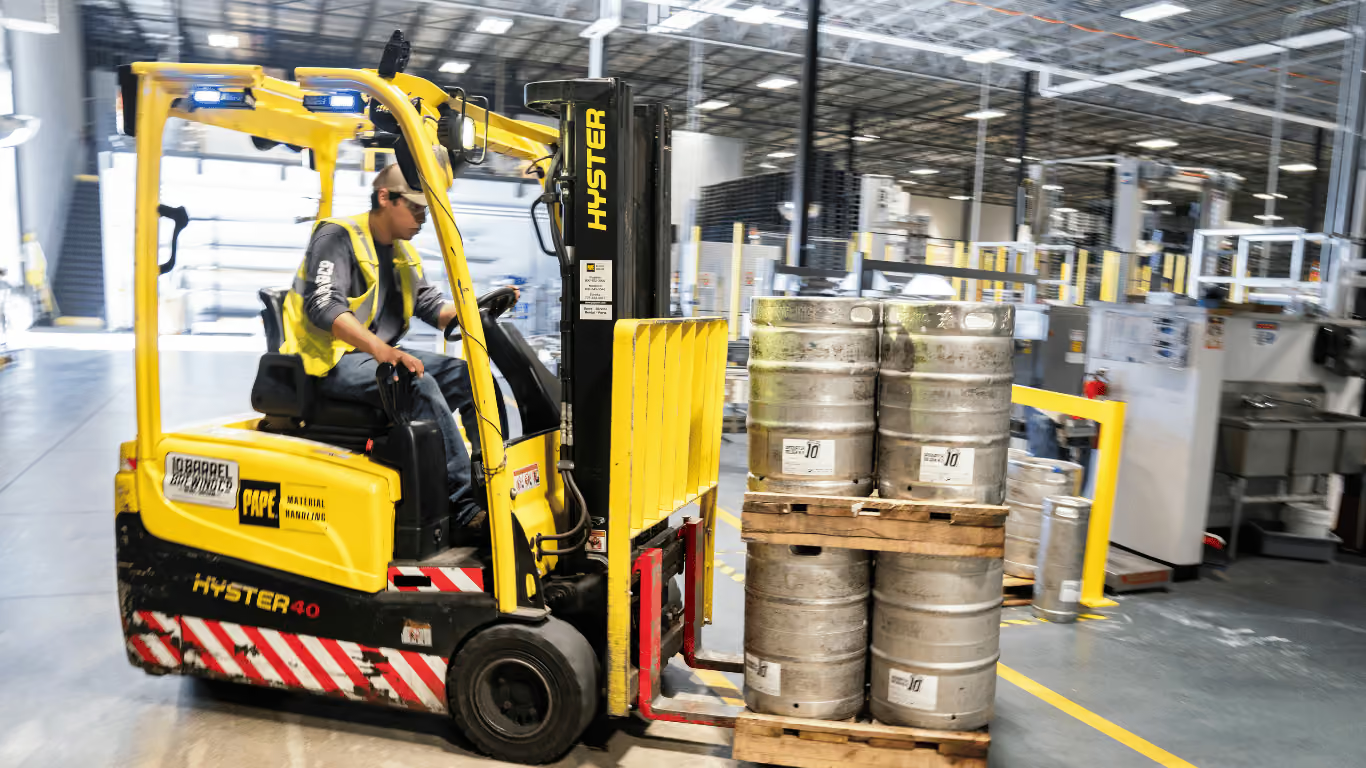
Forklift operator in a warehouse
Manufacturing worker at a workstation

The Cost of Relocation

How These Problems Actually Get Managed

In practice, manufacturing mobility succeeds through disciplined coordination.

We identify local housing constraints early so relocation timelines remain realistic. Supplier reliability matters more in secondary markets than in major metros. Exception patterns need to be monitored so policy does not drift under pressure. We monitor exception patterns so policies don't drift under pressure. We maintain tight communication between operations, HR, and relocation teams during expansion cycles.

This is where visibility, experience, and dependable partner execution matter. Not because they eliminate problems—but because they allow organizations to spot issues earlier, adjust quickly, and keep relocation aligned with operational priorities.

When to Reach Out for Help

By the time relocation problems become visible, they are often already affecting operations. The better approach isidentifyingpressure points early and putting the right structure around them before timelines tighten.

In manufacturing environments, mobility works best when potential friction is addressed before it begins to compound.That’swhere early collaboration with an experienced partner can make the difference between reactive problem-solving and disciplined execution.

Manufacturing organizations often begin working with NEI when they know challenges are likely to emerge.

Upcoming plant launches or major facility expansions

where talent deployment must stay aligned with production readiness

Upcoming plant launches or major facility expansions

where talent deployment must stay aligned with production readiness

Upcoming plant launches or major facility expansions

where talent deployment must stay aligned with production readiness

Life Sciences Relocation Programs

Why Relocation Carries More Weight in Life Sciences

In many research environments, work cannot proceed unless a qualified scientist is physically present.

Laboratories commonly restrict technicians from conducting hazardous procedures alone. Federal safety standards and institutional policies often require a PhD-level researcher or Principal Investigator to oversee certain experiments involving hazardous chemicals, biohazards, or complex biological systems.

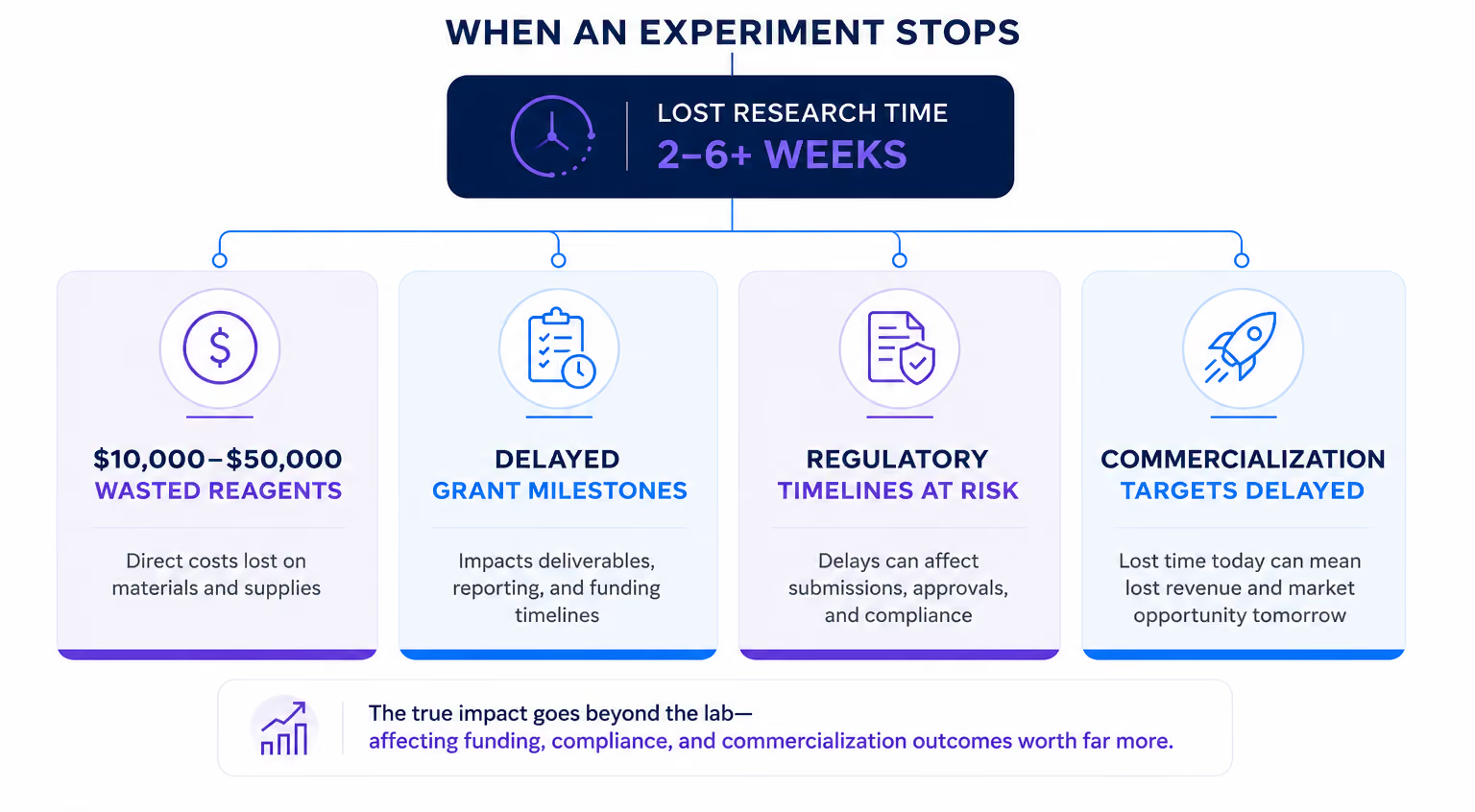
Infographic showing the impact of a halted experiment

A halted experiment can mean weeks of lost research time, $10,000–$50,000 in wasted reagents, and delayed milestones on grant-funded programs or clinical pipelines. In some cases, the delay affects regulatory timelines or commercialization targets worth far more.

When that oversight is missing, the work stops.

In environments like this, talent mobility is not simply an employee benefit.

It is part of how research timelines, compliance obligations, and financial investment stay on track.

What Makes Relocation Difficult in Life Sciences?

Relocations for Manufacturing are often tied to operational deadlines, inflexible hiring timelines. A delayed move can affect a plant launch, expansion, leadership transition, or production ramp-up.

Highly specialized talent is difficult to persuade to move.

Many scientists already hold stable positions, have access to grant funding, or work within research ecosystems they are reluctant to leave. Housing supply may be limited near facilities. Policy exceptions increase when local realities conflict with standardised benefits.

Research hubs create housing pressure.

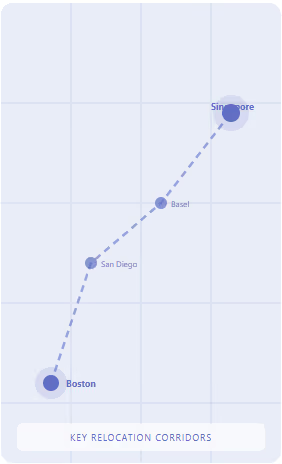
Major Life Sciences clusters—Boston, San Diego, the Bay Area, Basel, Singapore—often have constrained housing markets that complicate relocation timelines.

Learn More >

Regulatory and lab access requirements can delay onboarding.

Even when an employee arrives, credentialing, safety certifications, and facility approvals may still gate when work can begin.

Learn More >

Dual-career households are common.

Spouses or partners often work in similarly specialized fields, making location decisions more complex.

Learn More >

Research continuity expectations are high.

Teams, experiments, and funding timelines continue moving, which means relocation delays create ripple effects across projects.

Learn More >

None of these challenges are unusual in Life Sciences. But together they make relocation outcomes less predictable—and execution quality far more important.

Life Sciences Mobility Diagnostic

Answer a few quick questions and we'll point you toward the most relevant insights, tools, or guidance for your situation.

Life Sciences mobility programs rarely struggle for the same reasons. Some organizations face tight research timelines. Others are navigating housing constraints in major hubs, relocating highly specialized scientists, or scaling teams quickly.

Best Practices

In Life Sciences environments, successful relocation programs tend to focus on a few practical disciplines.

Key relocation corridors map
Life sciences professional

What It Takes to Keep Relocation From Slowing the Work

What It Takes to Keep Relocation From Slowing the Work

Planning moves earlier in the hiring cycle.

When talent is scarce and relocation markets are tight, waiting until an offer is accepted to begin planning often compresses timelines unnecessarily.

Setting realistic expectations around destination markets.

Housing constraints in major research hubs can affect timing and acceptance, so relocation timelines must reflect local conditions.

Supporting the full decision to move.

When dual-career households or specialized professionals are involved, relocation success often depends on addressing family, housing, and community considerations alongside the logistics of the move.

None of these challenges are unusual in Life Sciences. But together they make relocation outcomes less predictable—and execution quality far more important.

Finance professionalFinancial documents and charts

Keeping careers moving forward

Keep Licensed Professionals Moving

Many professionals in banking, asset management, and insurance operate under licenses tied to specific jurisdictions. When those professionals relocate, approvals often need to transfer before they can resume certain responsibilities.

Until that happens, authority may shift to other licensed personnel, client coverage may be reassigned, and oversight structures may temporarily change.

For institutions operating under regulatory scrutiny and fiduciary duty, even short disruptions create exposure.

That is why mobility in Finance and Insurance is rarely treated as a routine employee move—it is part of maintaining regulatory control and client stability during talent transitions.

Colleagues reviewing laptopFinancial professional reviewing tablet

Where Mobility Becomes Difficult

Where Mobility Becomes Difficult — And How Institutions Manage It

Several realities shape how relocation must be handled in financial institutions.

Jurisdictional licensing.

Moves across state or national lines can require registration transfers or regulatory notifications before professionals can resume certain responsibilities. NEI works with client teams to account for these timelines early so licensing transitions align with relocation planning.

Client relationship continuity.

Senior professionals often manage portfolios or advisory relationships that must remain stable during a transition. NEI helps coordinate relocation timing and communication planning so institutions maintain continuity with clients while leadership moves occur.

Global financial hubs.

Major finance centers—New York, London, Zurich, Singapore—present housing competition and compressed relocation timelines. As is also true in Life Sciences clusters, destination realities must be accounted for early so relocation schedules remain realistic.

Highly compensated talent.

Relocation decisions often involve negotiation, retention dynamics, and competing opportunities. NEI supports the broader decision to move by coordinating relocation services that address family, housing, and destination considerations alongside the logistics.

Confidential leadership transitions.

Executive relocations frequently occur under conditions requiring discretion and careful coordination across HR, compliance, and leadership teams. NEI's coordinated approach helps institutions manage these moves carefully while maintaining visibility into timelines and outcomes.

Individually, these challenges are manageable. But when they intersect, relocation requires the same discipline and foresight institutions apply to other areas of operational risk.

NEI's integrated approach—combining experienced mobility leadership, technology-driven visibility, and a trusted partner network—helps financial institutions move critical talent while maintaining continuity, compliance, and control.

Step-Through Assessment

Finance & Insurance Mobility Diagnostic

Relocation challenges in financial institutions rarely look the same. Some organizations are navigating licensing transfers tied to jurisdiction. Others are relocating professionals into global financial centers or managing leadership transitions where discretion and timing matter.

Why it matters

Answer a few quick questions and we'll point you toward insights, tools, or guidance that align with your situation.

What you will get

Tailored guidance on licensing timelines, client continuity planning, destination housing realities, and leadership transition support.

Energy & Utilities Relocation Programs

Why Talent Mobility Carries More Weight in Energy & Utilities

Large energy and infrastructure developments frequently carry capital budgets in the hundreds of millions—or even billions—of dollars, and construction phases often run on daily burn rates that can reach $500,000 to $1 million per day when labor, equipment, and contractors are mobilized. When key engineers, project leaders, or technical specialists cannot deploy on time, it shows up in idle crews, stalled commissioning, and schedules begin to slip. Energy and utilities organizations encounter a few recurring realities when deploying talent across infrastructure projects.

Highly specialized talent is difficult to persuade to move.

Many scientists already hold stable positions, have access to grant funding, or work within research ecosystems they are reluctant to leave. Housing supply may be limited near facilities. Policy exceptions increase when local realities conflict with standardised benefits.

Learn More >

Specialized technical roles.

Engineers, commissioning specialists, grid experts, and project leaders are not easily replaced. When relocation timelines slip, projects may continue mobilizing while critical expertise has yet to arrive. NEI helps organizations anticipate these risks by aligning relocation planning with hiring timelines and project deployment schedules.

Learn More >

Regulatory Environments

Energy projects often operate under strict permitting and environmental oversight that influences when work can proceed.

Electrical power lines at sunset
Technician reviewing server equipment

Through a combination of integrated technology, experienced mobility leadership, and a trusted global partner network

How NEI Helps Keep Projects Moving

NEI helps energy organizations move critical talent in a way that supports infrastructure schedules rather than introducing new delays. Regulatory and permitting environments require strict coordination. Energy projects often operate under strict permitting and environmental oversight that influences when work can proceed. NEI's coordinated approach helps ensure relocation planning supports these broader project constraints.

Through integrated technology, experienced mobility leadership, and a trusted global partner network, NEI helps energy organizations keep projects on track.

Where We Specialize

By the time relocation friction becomes obvious on an infrastructure project, the impact is often already visible in construction timelines, contractor coordination, or commissioning schedules. The better approach is identifying pressure points early and putting the right structure around workforce deployment before projects begin mobilizing.

Energy and utilities organizations often begin working with NEI when they see challenges emerging in areas like these.

In Energy and Utilities environments, mobility works best when workforce deployment is planned alongside infrastructure timelines. That's where early collaboration with an experienced relocation partner can help organizations keep projects moving, crews mobilized, and critical expertise in place when it's needed.

Engineer with tablet at industrial site

Upcoming infrastructure projects or major facility expansions

where engineers, project managers, and technical specialists must deploy in step with construction and commissioning timelines

Relocating employees to remote or infrastructure-heavy locations where housing availability and local services can influence relocation success

Specialized technical roles where delayed relocation can leave project teams waiting on critical expertise. Large capital projects mobilizing multiple teams where relocation timelines must stay aligned with contractor schedules and workforce planning.

Policy exceptions increasing as traditional relocation programs encounter the realities of remote project locations. Limited visibility into relocation timelines and costs while projects are already under way.

Cost Control & Program Efficiency

Technology. Experienced advisors. Established partner networks. In global mobility, these are table stakes and most credible RMCs can demonstrate all three.

Pricing Guide

How Relocation Pricing Actually Works

Most buyers never see the full pricing structure. Relocation Management Companies typically generate revenue through a combination of:

Management fees (per move or volume-based)

Embedded supplier costs or referral structures

Technology access

Consulting or policy services

Those mechanics influence transparency, vendor consolidation, and long-term spend behavior. When pricing models are misaligned with program objectives, spend can expand quietly over time. Cost control begins with understanding incentives.

Business meeting
Office scene
Person typing on laptop

The Variables That Actually Drive Spend

Relocation cost is shaped by more than policy generosity.

Key Drivers Include:

Exception frequency

Vendor fragmentation

Internal administrative lift

Volume volatility

Tax complexity

Time to fill and deployment delays

Short-term restriction can reduce visible expense.

But poorly structured restriction increases downstream cost through attrition, failed assignments, and redeployment delays. Strategic cost control balances containment with talent outcomes.

Colleagues reviewing documents

Tactical Spending Cuts vs. Strategic Cost Avoidance

Performance Separation Is Measurable.

The most effective mobility programs treat relocation as a strategic alignment of resources rather than a series of one-off expenses, prioritizing long-term cost avoidance over tactical spending cuts. This approach shifts focus from reactive, short-term savings to maximizing value by preventing failed assignments and accelerating employee productivity.

Strategic cost avoidance focuses on:

Preventing failed assignments

Reducing escalations

Accelerating ramp-up

Preserving key talent

Q & A

How Relocation Pricing Actually Works

Question 1

The most effective mobility programs treat relocation as a strategic alignment of resources rather than a series of one-off expenses, prioritizing long-term cost avoidance over tactical spending cuts. This approach shifts focus from reactive, short-term savings to maximizing value by preventing failed assignments and accelerating employee productivity.

Question 2

Question 3

Question 4

Ask Us Now

Don’t want to wait? We have sales representatives ready to speak with you now.

Name

Email

Question relation field

Colleagues reviewing documents
Woman smiling

The Cost of Relocation

What Does Relocation Cost?

It’s the right question.

But it’s usually incomplete. Relocation cost is not just the sum of benefits paid. It includes time to deployment, productivity ramp-up, policy leakage, vendor inefficiencies, tax exposure, retention risk, and internal administrative drag. The real cost of relocation is operational. Organizations that manage relocation tactically focus on individual line items.

Growth, M&A,  and Market Entry 

Technology. Experienced advisors. Established partner networks. In global mobility, these are table stakes and most credible RMCs can demonstrate all three.

When Expansion Accelerates, Coordination Matters Most

When Expansion Accelerates, Coordination Matters Most

Whether launching operations in a new market, integrating an acquired workforce, or scaling hiring across regions, organizations quickly discover that relocation is not simply about moving people.

It is about coordinating decisions, timelines, and partners across multiple stakeholders while the business continues moving forward.

When that coordination breaks down, expansion slows. Start dates slip. Exceptions multiply. Internal teams spend more time solving operational friction than advancing the strategy that drove the expansion in the first place.

Pricing Guide

Where These Needs Converge

Growth initiatives often look different on the surface—an acquisition, a new market launch, a rapid hiring push—but they place similar demands on a mobility program. In each scenario, the organization must manage:

Compressed timelines as roles need to be filled quickly

Increased move volume within a short period of time

Multiple stakeholders across HR, leadership, and local partners

Regulatory complexity in unfamiliar markets

Employee expectations that remain high even under pressure

What connects these situations is the need for a relocation model that can maintain alignment between information, decisions, and execution as complexity increases.

Colleagues discussing documents

The NEI Approach

At NEI, we approach expansion mobility as a coordination challenge. Visibility across moves allows emerging bottlenecks to be identified early.

Relocation cost is shaped by more than policy generosity.

Key coordination demands include:

Compressed timelines

Multiple stakeholders

Unfamiliar markets

Increased move volume

Regulatory complexity

Employee expectations

Mobility does not typically fail because moving employees is inherently difficult.

It fails when the systems surrounding those moves cannot keep pace with the growth of the business. Experienced teams review developments in context—considering cost, timing, regulatory implications, and employee impact before action is taken. Partners operate within shared expectations and defined escalation paths so execution remains consistent even as volume rises.

Colleagues reviewing documentsTeam meeting in glass office

The Result of Coordinated Expansion Mobility

Performance Separation Is Measurable.

This approach helps organizations maintain stability during moments when mobility programs are most likely to experience strain.

The result is not simply successful revocations. It is the ability to support business expansion without creating operational drag.

Strategic coordination focuses on:

Visibility across moves to identify emerging bottlenecks early

Experienced teams reviewing developments in context

Partners operating within shared expectations and defined escalation paths

Consistent execution even as volume rises

Where Needs Begin to Diverge

Where These Needs Converge

While growth, acquisitions, and market entry share common coordination challenges, each scenario introduces its own operational nuances. Understanding those differences is critical to ensuring relocation programs support the broader business objective.

Explore the specific considerations for each situation below.

Growth icon

Growth & Workforce Scaling

Periods of rapid hiring create sudden relocation demand. The challenge is supporting higher move volumes while maintaining consistency and employee experience.

Learn how mobility programs scale during growth →
Mergers and acquisitions icon

Mergers & Acquisitions

Acquisitions introduce overlapping policies, partner networks, and internal processes. Mobility programs must integrate employees smoothly while aligning new stakeholders.

Explore relocation strategy during M&A integration →
Market entry icon

Market Entry

Launching operations in a new geography introduces unfamiliar regulatory environments, local partners, and employee support expectations.

See how relocation supports successful market entry →
Mobility should strengthen expansion.
Not slow it down.

Most Failures Start Quietly

Mobility risk usually does not announce itself. It builds through small breakdowns that are easy to miss in the moment.

01

Late documentation

A required document arrives late, creating a gap between expected and actual clearance.

02

Unreviewed exceptions

A policy exception moves forward without enough review.

03

Misaligned urgency

A partner interprets urgency differently than the client does.

04

Slow response to visible issues

A developing issue is visible, but no one acts quickly enough.

05

Unclear ownership

A case crosses tax, immigration, and logistics concerns without clear ownership.

These are not dramatic failures at first. They become serious when they are not surfaced, interpreted, and managed in time. That is the real threat: not disruption itself, but silent failure.

Risk Signal

That is why compliance in relocation is not just about expertise. It is about control.

When risk is managed loosely, the consequences do not stay contained to the move. They affect cost, credibility, employee experience, and leadership trust in the program itself.

Relocation is high-stakes and low-forgiveness.

Reviewing compliance data

The NEI Difference

Status alone is not enough. What matters is whether developing issues are reviewed in context, assigned clear ownership, and moved through defined escalation paths before consequences expand.

NEI's model is designed to reduce the likelihood that small issues turn into larger incidents.

Life Sciences Relocation Programs

Why Relocation Carries More Weight in Life Sciences

In many research environments, work cannot proceed unless a qualified scientist is physically present.

Laboratories commonly restrict technicians from conducting hazardous procedures alone. Federal safety standards and institutional policies often require a PhD-level researcher or Principal Investigator to oversee certain experiments involving hazardous chemicals, biohazards, or complex biological systems.

01

Exception frequency

Cost, timing, and compliance implications are assessed together before action is taken.

02

Decisions made with downstream impact in mind

What resolves an issue today should not create a new one tomorrow.

03

Partners operating within clear expectations

Communication, escalation, and follow-through are defined—not assumed.

04

Accountability visible across the life of the move

Ownership does not disappear once a case is handed off.

What Auditability Actually Looks Like

What Auditability Actually Looks Like

Auditability is not a slogan. It is the ability to show how a decision was made, when it was made, who owned it, and what happened next.

For clients, that matters when legal, HR, procurement, finance, or leadership need answers.

NEI is structured to support that level of clarity. The goal is not just to manage moves, but to make the program more defensible when scrutiny increases.

That is why compliance in relocation is not just about expertise. It is about control.

What Changed

The specific shift in circumstance, requirement, or status that triggered a decision.

When it changed

A clear timestamp tied to the point of detection and the point of action.

How it was assessed

What information was considered, and what context informed the response.

Who was responsible

Named ownership at every stage of the move lifecycle.

How the issue was resolved

The outcome, the path taken, and any implications carried forward.

Where This Matters Most

These are the five areas where mobility risk is most likely to surface—and where disciplined program management makes the clearest difference.

Immigration & Regulatory Exposure

When timing shifts, documentation slips, or jurisdictional requirements change, the risk is not just delay. It is business interruption and compliance exposure.

Tax & Payroll Alignment

A mobility decision made in one area can create unintended consequences in another. Risk increases when assignment structure, payroll treatment, and policy intent are not tightly aligned.

Duty of Care

Employees need more than support. They need a program with visible oversight, clear ownership, and reliable follow-through when circumstances change.

Data & Security

Relocation involves sensitive employee information. Risk rises when access, communication, and responsibility are fragmented across too many parties.

Escalation Discipline

The issue is rarely whether a problem exists. The issue is whether it reaches the right people early enough to contain it.

01

Fewer issues linger without action

Defined escalation paths mean developing situations are acted on before they compound.

02

Escalations happen earlier and with more clarity

The right people are informed at the right time with the right context.

03

Policy decisions are easier to defend

Documented rationale and clear ownership make exceptions traceable.

04

Accountability is easier to trace

Every decision has a named owner and a documented outcome.

05

Leaders have more confidence in the stability of the program

Visibility and rigor replace reliance on individual judgment under pressure.

What This Means for Your Program

What This Means for Your Program

When compliance and risk management are handled with discipline, the benefits are practical.

The point is not to promise a program without issues. The point is to run a program where issues are less likely to become business incidents.

Why This Outcome Matters

NEI's approach is built for auditability, rigor, escalation discipline, and the prevention of silent failures— so your program is not just active, but controlled.

Relocation is high-stakes and low-forgiveness. When risk is managed loosely, the consequences do not stay contained to the move. They affect cost, credibility, employee experience, and leadership trust in the program itself.

Why Care About Employee Experience & Talent Success?

Relocation is usually triggered by a business need. If the employee experience around that move is poorly managed, several things begin to happen that carry real business cost.

COST #1

Relocation acceptance drops

Talented employees often have options. When the process feels uncertain—housing is unclear, timelines feel chaotic, family needs aren't addressed—employees become hesitant. A declined relocation often sends hiring back to the beginning, delaying projects or leadership transitions by months.

COST #2

Time-to-productivity increases

Even when the employee accepts, a poorly managed relocation extends the time it takes for them to stabilize personally. If housing, schools, or local logistics remain unresolved, attention is divided. The role is filled, but the employee cannot fully focus on delivering results yet.

COST #3

Retention risk rises after the move

Employees who relocate under stress sometimes reassess the decision shortly after arriving. When relocation dissatisfaction leads to turnover within the first year, the organization absorbs the cost of both the move and the replacement hire.

COST #4

Program costs quietly increase

When employee needs were not anticipated early, organizations often compensate through policy exceptions, additional benefits, or leadership intervention. These reactive adjustments create cost variability that is difficult to forecast or control.

Taken together, these effects show why employee experience is not simply a "people-first" gesture within mobility programs. It is a practical factor that influences acceptance rates, productivity ramp-up, retention, and overall relocation cost efficiency.

When the experience is managed well, relocation supports talent deployment smoothly. When it is not, the organization ends up paying for the same move several times over—through delays, lost productivity, and replacement hiring.

Employee experience is not simply a "people-first" gesture. It is a practical factor that influences acceptance rates, productivity, retention, and overall relocation cost efficiency.

Managing the Employee Experience

Managing the Employee Experience

The employee experience in relocation is not driven by a single factor. It is shaped by a handful of operational levers that influence how confident an employee feels about uprooting their life and starting in a new place.

Organizations that manage these levers well tend to see stronger relocation acceptance, faster transitions, and lower hidden costs.

1. Expectation Setting
2. Coordination & Communication
3. Policy Clarity & Flexibility
4. Destination Services
5. Program Visibility

01 of 05

Expectation Setting

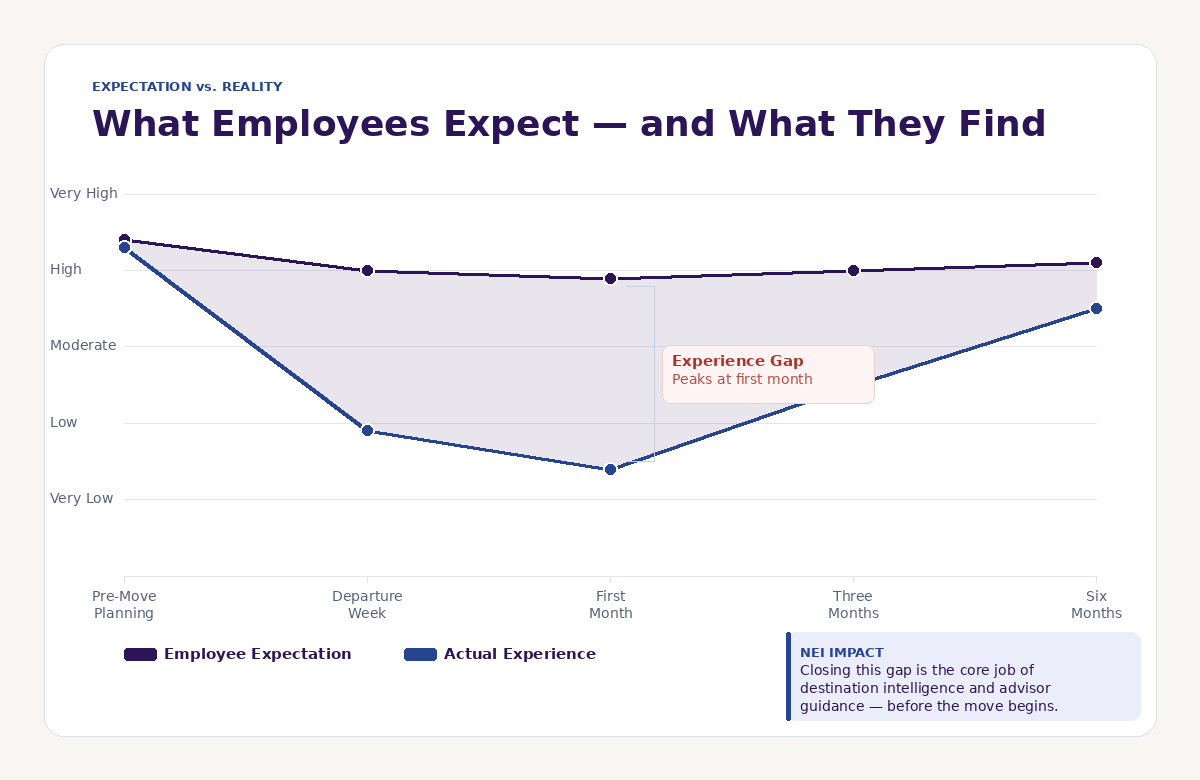
One of the biggest drivers of relocation stress is uncertainty. Employees often begin the process with incomplete assumptions about housing timelines, cost of living differences, or how long it will realistically take to settle into the destination market.

When expectations are misaligned, the relocation experience can quickly feel chaotic—even if the logistics are technically handled well.

Expectation versus reality comparison

How NEI Helps

NEI helps control this lever by combining destination intelligence, experienced mobility advisors, and a global partner network that can surface local realities early. Employees gain a clearer understanding of what to expect before the move begins, which reduces hesitation and prevents surprises that often lead to policy exceptions or relocation dissatisfaction.

Why Care About Employee Experience & Talent Success?

Relocation is usually triggered by a business need. If the employee experience around that move is poorly managed, several things begin to happen that carry real business cost.

Technology that provides visibility

NEI's platform gives organizations real-time insight into relocation progress and program performance—so issues are caught before they reach the employee.

Experienced mobility professionals

Mobility specialists guide organizations through complex relocation scenarios—anticipating friction points and coordinating across all stakeholders before problems compound.

A global network of trusted partners

Vetted local specialists capable of delivering reliable destination support—the expertise that determines whether employees feel supported or overwhelmed during the transition.

Stronger relocation acceptance

Employees who understand the process and feel supported are more likely to say yes—and stay yes.

Faster productivity ramp-up

When personal logistics are resolved quickly, employees can focus on the work they were hired to do.

Improved retention

When the employee experience improves, the business outcomes behind relocation tend to improve alongside it.

Where We Specialize

Different industries face different mobility pressures. We’ve built deep
expertise across manufacturing, life sciences, energy, and finance to
understand what drives your assignments and what can derail them.

Where We Specialize

Different industries face different mobility pressures. We've built deep expertise across manufacturing, life sciences, energy, and finance to understand what drives your assignments and what can derail them.

Manufacturing professionals coordinating production operations

Manufacturing

Move production teams and operations leaders globally

Manufacturing expansions and facility relocations demand precision timing and coordination across multiple countries. NEI manages the complexity of moving technical talent, securing compliance across jurisdictions, and keeping operations on schedule while your people settle.

Life sciences professionals collaborating with an employee

Life Sciences

Move critical talent without slowing innovation

From research teams to specialized leadership, life sciences mobility requires speed, compliance, and care. NEI coordinates the details so employees can transition confidently while your organization protects continuity and momentum.

Digital network representing finance and insurance mobility

Finance & Insurance

Protect continuity while moving high-value talent

Financial organizations need mobility programs that balance speed, discretion, risk controls, and a consistent employee experience. NEI brings the oversight and visibility needed to keep complex moves aligned with business priorities.

Energy professional working near wind turbines

Mobilize specialized teams wherever operations demand

Energy & Utilities

Energy and utility assignments often involve remote locations, tight schedules, and specialized compliance requirements. NEI helps move critical talent efficiently while keeping employees supported and operations on track.