.png)
When Rent Outpaces Income: What It Means for Relocation Programs
A large share of the renting population today is paying more for housing than they may reasonably afford. What can companies do to support such relocating employees?
Hotspots Where Renting is Tightest
The median price for a home sold in January 2026 was $396,800, up 0.9% year over year -- the highest January price on record -- but rental affordability also continues to be an issue across many U.S. states and securing stable, affordable housing will continue to require income levels that are out of reach for many.10
- U.S. Census Bureau data shows 21 million renter households -- or 49.7% of renters -- spent more than 30% percent of their income on housing (rent plus utilities).1
- Between 2019 and 2023 the share of renters with cost burdens increased in 43 of 50 U.S. states and 89 of the 100 largest metro areas.3
- Between 2017 and 2025, median weekly earnings grew by 38%, while rents increased by 50%.9
When considering specific metro areas in the U.S., 12.1 million renter households were identified as “severely cost-burdened” (spending over 50% of income on housing).2
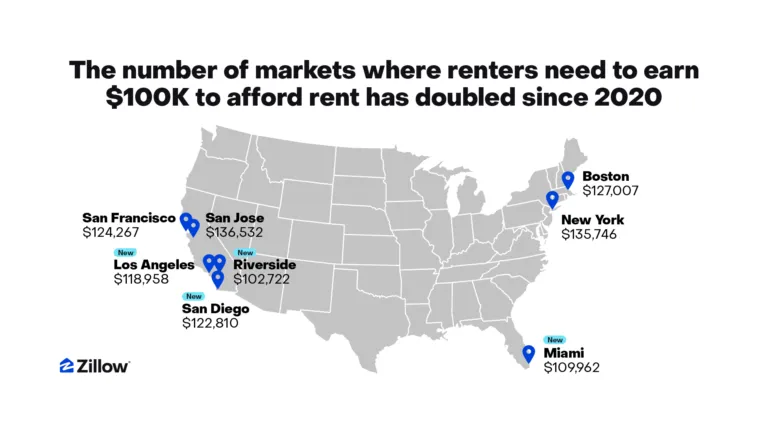
- New York City, San Jose, and Boston are among the most demanding markets in terms of income needed to rent comfortably.4
- Florida metros show over 60% of renters were reported as “cost burdened” (spending 30%+ of income on housing).5
- The San Francisco Bay Area shows 56% of renters also as cost burdened, especially in outer suburban areas.6
Supply constraints and cost pressures prove a mismatch between demand and available affordable rental supply while rising construction/land costs can worsen the situation.
Why Renters are Stretched Thin
A 2025 Zillow analysis found renters in eight major U.S. metro areas now need to earn over $100K annually to “comfortably afford” typical rents – up double since 2020.4
When asked what would motivate them to move, renters say affordability is a top reason for all age groups and areas sought out are where rental prices have dropped most. These include Las Vegas, metro Atlanta, and Austin as well as the most affordable markets with the lowest required income of Buffalo ($55K income), Oklahoma City ($56K) and Louisville ($57K).7
“Renters focused on affordability are often willing to make compromises, like choosing a longer commute, fewer amenities or fewer on-site services,” said Jiayi Xu, Economist at Realtor.com. “It shows that many households are carefully weighing costs against lifestyle, making tradeoffs to find a home that better fits their budget.” 8
How Employers Can Help Relocating Renters
For companies, these affordability pressures cannot be ignored. Relocating renters moving to high-cost cities face both sticker shock and financial stress, which can affect retention and performance. Employers can provide support such as:
- High cost of housing assistance or rental assistance to offset cost burdens in expensive metros
- Flexible location policies that allow remote or a hybrid work week where possible, giving employees options to live in more affordable markets
- Increased rental finding and counseling so employees can make informed choices
- Opportunities to explore home purchase such as real estate referrals, mortgage counseling, and new home closing cost reimbursements
NEI Global helps play a critical role for clients and renting transferees by leveraging local service partners and their market expertise through:
- Conducting destination housing affordability assessments before moves
- Integrating destination location planning tools into client relocation offer packages to help employees balance rent with other expenses
- Negotiating with landlords and corporate housing providers to secure competitive lease terms
- Offering short-term housing or temporary accommodation solutions to ease transitions
- Educating employees and clients on purchase opportunities when rental affordability and/or availability is out of reach
These strategies offered to relocating employees can help candidates make informed decisions and mitigate the immediate financial strain employees face when relocating into high-rent environments.
Not Confined to the Coasts
Millions of renters are locked into housing budgets that strain their expenses. Relocation professionals, recruiters, and hiring managers are encouraged to recognize these obstacles and consider all proactive measures possible to secure and relocate the talent you need.
If you would like to discuss this or any other issue in greater detail, please reach out to your NEI representative at 800.533.7353.
About NEI Global Relocation
NEI, a certified Women’s Business Enterprise (WBE), partners with over 200 clients—including Fortune Global 100, Fortune 500, and Fortune 1000 companies—to deliver world-class global mobility and assignment management solutions. Headquartered in Omaha, Nebraska, with offices in Switzerland and Singapore, NEI helps companies transition employees smoothly across the globe.
NEI has consistently earned strong rankings in independent industry surveys, including the Trippel Nationwide Relocating Employee Survey and the Trippel Relocation Managers’ Survey, which highlight performance in both employee experience and client satisfaction. Recently, NEI has also been honored with multiple Gold Stevie® Awards, including recognition for Company of the Year – Business or Professional Services and Customer Satisfaction at the International and American Business Awards. These accolades reflect NEI’s commitment to service excellence and its leadership in the global mobility industry.
Combining consultative expertise, benchmarking, trend analysis, innovative technology, and end-to-end relocation solutions, NEI empowers organizations to make confident global mobility decisions and deliver exceptional relocation experiences.
This material has been prepared for informational purposes only and is not intended to provide, and should not be relied on for tax, legal or accounting advice. Please consult your own tax, legal and accounting advisors before engaging in any transaction.
Sources
- U.S. Census Bureau: “Nearly Half of Renter Households Are Cost Burdened” (census.gov)
- Novoco: “CHS Update to the American Rental Housing Report” (novoco.com)
- NCSHA: “Annual JCHS Report Finds Housing Affordability Challenges Persist; Issues Strong Call for Action” (ncsha.org)
- Zillow: “Renters Need to Earn $100K in Twice as Many Markets Than in 2020” (Zillow)
- Business Insider: “U.S. Cities Where Renters Struggle the Most” (businessinsider.com)
- SFChronicle: “Most Bay Area renters are ‘cost-burdened’ — especially in these areas” (sfchronicle.com)
- Realtor.com: “August 2025 Rental Report: Two Years of Declining Rents Have Renters Ready To Make a Move” (realtor.com)
- MortgagePoint: “Renters Move Toward Better Affordability as Prices Ease” (mortgagepoint)
- The Urban Institute: “In an affordability crunch, Gen Z adults are leaning on their parents for financial help” (CNBC.com)
- CNBC: “Realtors report a ‘new housing crisis” (CNBC.com)
When Rent Outpaces Income: What It Means for Relocation Programs
A large share of the renting population today is paying more for housing than they may reasonably afford. What can companies do to support such relocating employees?
Hotspots Where Renting is Tightest
The median price for a home sold in January 2026 was $396,800, up 0.9% year over year -- the highest January price on record -- but rental affordability also continues to be an issue across many U.S. states and securing stable, affordable housing will continue to require income levels that are out of reach for many.10
- U.S. Census Bureau data shows 21 million renter households -- or 49.7% of renters -- spent more than 30% percent of their income on housing (rent plus utilities).1
- Between 2019 and 2023 the share of renters with cost burdens increased in 43 of 50 U.S. states and 89 of the 100 largest metro areas.3
- Between 2017 and 2025, median weekly earnings grew by 38%, while rents increased by 50%.9
When considering specific metro areas in the U.S., 12.1 million renter households were identified as “severely cost-burdened” (spending over 50% of income on housing).2
- New York City, San Jose, and Boston are among the most demanding markets in terms of income needed to rent comfortably.4
- Florida metros show over 60% of renters were reported as “cost burdened” (spending 30%+ of income on housing).5
- The San Francisco Bay Area shows 56% of renters also as cost burdened, especially in outer suburban areas.6
Supply constraints and cost pressures prove a mismatch between demand and available affordable rental supply while rising construction/land costs can worsen the situation.
Why Renters are Stretched Thin
A 2025 Zillow analysis found renters in eight major U.S. metro areas now need to earn over $100K annually to “comfortably afford” typical rents – up double since 2020.4
When asked what would motivate them to move, renters say affordability is a top reason for all age groups and areas sought out are where rental prices have dropped most. These include Las Vegas, metro Atlanta, and Austin as well as the most affordable markets with the lowest required income of Buffalo ($55K income), Oklahoma City ($56K) and Louisville ($57K).7
“Renters focused on affordability are often willing to make compromises, like choosing a longer commute, fewer amenities or fewer on-site services,” said Jiayi Xu, Economist at Realtor.com. “It shows that many households are carefully weighing costs against lifestyle, making tradeoffs to find a home that better fits their budget.” 8
How Employers Can Help Relocating Renters
For companies, these affordability pressures cannot be ignored. Relocating renters moving to high-cost cities face both sticker shock and financial stress, which can affect retention and performance. Employers can provide support such as:
- High cost of housing assistance or rental assistance to offset cost burdens in expensive metros
- Flexible location policies that allow remote or a hybrid work week where possible, giving employees options to live in more affordable markets
- Increased rental finding and counseling so employees can make informed choices
- Opportunities to explore home purchase such as real estate referrals, mortgage counseling, and new home closing cost reimbursements
NEI Global helps play a critical role for clients and renting transferees by leveraging local service partners and their market expertise through:
- Conducting destination housing affordability assessments before moves
- Integrating destination location planning tools into client relocation offer packages to help employees balance rent with other expenses
- Negotiating with landlords and corporate housing providers to secure competitive lease terms
- Offering short-term housing or temporary accommodation solutions to ease transitions
- Educating employees and clients on purchase opportunities when rental affordability and/or availability is out of reach
These strategies offered to relocating employees can help candidates make informed decisions and mitigate the immediate financial strain employees face when relocating into high-rent environments.
Not Confined to the Coasts
Millions of renters are locked into housing budgets that strain their expenses. Relocation professionals, recruiters, and hiring managers are encouraged to recognize these obstacles and consider all proactive measures possible to secure and relocate the talent you need.
If you would like to discuss this or any other issue in greater detail, please reach out to your NEI representative at 800.533.7353.
About NEI Global Relocation
NEI, a certified Women’s Business Enterprise (WBE), partners with over 200 clients—including Fortune Global 100, Fortune 500, and Fortune 1000 companies—to deliver world-class global mobility and assignment management solutions. Headquartered in Omaha, Nebraska, with offices in Switzerland and Singapore, NEI helps companies transition employees smoothly across the globe.
NEI has consistently earned strong rankings in independent industry surveys, including the Trippel Nationwide Relocating Employee Survey and the Trippel Relocation Managers’ Survey, which highlight performance in both employee experience and client satisfaction. Recently, NEI has also been honored with multiple Gold Stevie® Awards, including recognition for Company of the Year – Business or Professional Services and Customer Satisfaction at the International and American Business Awards. These accolades reflect NEI’s commitment to service excellence and its leadership in the global mobility industry.
Combining consultative expertise, benchmarking, trend analysis, innovative technology, and end-to-end relocation solutions, NEI empowers organizations to make confident global mobility decisions and deliver exceptional relocation experiences.
This material has been prepared for informational purposes only and is not intended to provide, and should not be relied on for tax, legal or accounting advice. Please consult your own tax, legal and accounting advisors before engaging in any transaction.
Sources
- U.S. Census Bureau: “Nearly Half of Renter Households Are Cost Burdened” (census.gov)
- Novoco: “CHS Update to the American Rental Housing Report” (novoco.com)
- NCSHA: “Annual JCHS Report Finds Housing Affordability Challenges Persist; Issues Strong Call for Action” (ncsha.org)
- Zillow: “Renters Need to Earn $100K in Twice as Many Markets Than in 2020” (Zillow)
- Business Insider: “U.S. Cities Where Renters Struggle the Most” (businessinsider.com)
- SFChronicle: “Most Bay Area renters are ‘cost-burdened’ — especially in these areas” (sfchronicle.com)
- Realtor.com: “August 2025 Rental Report: Two Years of Declining Rents Have Renters Ready To Make a Move” (realtor.com)
- MortgagePoint: “Renters Move Toward Better Affordability as Prices Ease” (mortgagepoint)
- The Urban Institute: “In an affordability crunch, Gen Z adults are leaning on their parents for financial help” (CNBC.com)
- CNBC: “Realtors report a ‘new housing crisis” (CNBC.com)
When Rent Outpaces Income: What It Means for Relocation Programs
A large share of the renting population today is paying more for housing than they may reasonably afford. What can companies do to support such relocating employees?
Hotspots Where Renting is Tightest
The median price for a home sold in January 2026 was $396,800, up 0.9% year over year -- the highest January price on record -- but rental affordability also continues to be an issue across many U.S. states and securing stable, affordable housing will continue to require income levels that are out of reach for many.10
- U.S. Census Bureau data shows 21 million renter households -- or 49.7% of renters -- spent more than 30% percent of their income on housing (rent plus utilities).1
- Between 2019 and 2023 the share of renters with cost burdens increased in 43 of 50 U.S. states and 89 of the 100 largest metro areas.3
- Between 2017 and 2025, median weekly earnings grew by 38%, while rents increased by 50%.9
When considering specific metro areas in the U.S., 12.1 million renter households were identified as “severely cost-burdened” (spending over 50% of income on housing).2
- New York City, San Jose, and Boston are among the most demanding markets in terms of income needed to rent comfortably.4
- Florida metros show over 60% of renters were reported as “cost burdened” (spending 30%+ of income on housing).5
- The San Francisco Bay Area shows 56% of renters also as cost burdened, especially in outer suburban areas.6
Supply constraints and cost pressures prove a mismatch between demand and available affordable rental supply while rising construction/land costs can worsen the situation.
Why Renters are Stretched Thin
A 2025 Zillow analysis found renters in eight major U.S. metro areas now need to earn over $100K annually to “comfortably afford” typical rents – up double since 2020.4
When asked what would motivate them to move, renters say affordability is a top reason for all age groups and areas sought out are where rental prices have dropped most. These include Las Vegas, metro Atlanta, and Austin as well as the most affordable markets with the lowest required income of Buffalo ($55K income), Oklahoma City ($56K) and Louisville ($57K).7
“Renters focused on affordability are often willing to make compromises, like choosing a longer commute, fewer amenities or fewer on-site services,” said Jiayi Xu, Economist at Realtor.com. “It shows that many households are carefully weighing costs against lifestyle, making tradeoffs to find a home that better fits their budget.” 8
How Employers Can Help Relocating Renters
For companies, these affordability pressures cannot be ignored. Relocating renters moving to high-cost cities face both sticker shock and financial stress, which can affect retention and performance. Employers can provide support such as:
- High cost of housing assistance or rental assistance to offset cost burdens in expensive metros
- Flexible location policies that allow remote or a hybrid work week where possible, giving employees options to live in more affordable markets
- Increased rental finding and counseling so employees can make informed choices
- Opportunities to explore home purchase such as real estate referrals, mortgage counseling, and new home closing cost reimbursements
NEI Global helps play a critical role for clients and renting transferees by leveraging local service partners and their market expertise through:
- Conducting destination housing affordability assessments before moves
- Integrating destination location planning tools into client relocation offer packages to help employees balance rent with other expenses
- Negotiating with landlords and corporate housing providers to secure competitive lease terms
- Offering short-term housing or temporary accommodation solutions to ease transitions
- Educating employees and clients on purchase opportunities when rental affordability and/or availability is out of reach
These strategies offered to relocating employees can help candidates make informed decisions and mitigate the immediate financial strain employees face when relocating into high-rent environments.
Not Confined to the Coasts
Millions of renters are locked into housing budgets that strain their expenses. Relocation professionals, recruiters, and hiring managers are encouraged to recognize these obstacles and consider all proactive measures possible to secure and relocate the talent you need.
If you would like to discuss this or any other issue in greater detail, please reach out to your NEI representative at 800.533.7353.
About NEI Global Relocation
NEI, a certified Women’s Business Enterprise (WBE), partners with over 200 clients—including Fortune Global 100, Fortune 500, and Fortune 1000 companies—to deliver world-class global mobility and assignment management solutions. Headquartered in Omaha, Nebraska, with offices in Switzerland and Singapore, NEI helps companies transition employees smoothly across the globe.
NEI has consistently earned strong rankings in independent industry surveys, including the Trippel Nationwide Relocating Employee Survey and the Trippel Relocation Managers’ Survey, which highlight performance in both employee experience and client satisfaction. Recently, NEI has also been honored with multiple Gold Stevie® Awards, including recognition for Company of the Year – Business or Professional Services and Customer Satisfaction at the International and American Business Awards. These accolades reflect NEI’s commitment to service excellence and its leadership in the global mobility industry.
Combining consultative expertise, benchmarking, trend analysis, innovative technology, and end-to-end relocation solutions, NEI empowers organizations to make confident global mobility decisions and deliver exceptional relocation experiences.
This material has been prepared for informational purposes only and is not intended to provide, and should not be relied on for tax, legal or accounting advice. Please consult your own tax, legal and accounting advisors before engaging in any transaction.
Sources
- U.S. Census Bureau: “Nearly Half of Renter Households Are Cost Burdened” (census.gov)
- Novoco: “CHS Update to the American Rental Housing Report” (novoco.com)
- NCSHA: “Annual JCHS Report Finds Housing Affordability Challenges Persist; Issues Strong Call for Action” (ncsha.org)
- Zillow: “Renters Need to Earn $100K in Twice as Many Markets Than in 2020” (Zillow)
- Business Insider: “U.S. Cities Where Renters Struggle the Most” (businessinsider.com)
- SFChronicle: “Most Bay Area renters are ‘cost-burdened’ — especially in these areas” (sfchronicle.com)
- Realtor.com: “August 2025 Rental Report: Two Years of Declining Rents Have Renters Ready To Make a Move” (realtor.com)
- MortgagePoint: “Renters Move Toward Better Affordability as Prices Ease” (mortgagepoint)
- The Urban Institute: “In an affordability crunch, Gen Z adults are leaning on their parents for financial help” (CNBC.com)
- CNBC: “Realtors report a ‘new housing crisis” (CNBC.com)