

Talent & Leadership Mobility
Companies should care about the employee experience in relocation because it directly affects whether the investment in talent actually produces value.

Why Care About Employee Experience & Talent Success?
Relocation is usually triggered by a business need. If the employee experience around that move is poorly managed, several things begin to happen that carry real business cost.
COST #1
Relocation acceptance drops
Talented employees often have options. When the process feels uncertain—housing is unclear, timelines feel chaotic, family needs aren't addressed—employees become hesitant. A declined relocation often sends hiring back to the beginning, delaying projects or leadership transitions by months.
COST #2
Time-to-productivity increases
Even when the employee accepts, a poorly managed relocation extends the time it takes for them to stabilize personally. If housing, schools, or local logistics remain unresolved, attention is divided. The role is filled, but the employee cannot fully focus on delivering results yet.
COST #3
Retention risk rises after the move
Employees who relocate under stress sometimes reassess the decision shortly after arriving. When relocation dissatisfaction leads to turnover within the first year, the organization absorbs the cost of both the move and the replacement hire.
COST #4
Program costs quietly increase
When employee needs were not anticipated early, organizations often compensate through policy exceptions, additional benefits, or leadership intervention. These reactive adjustments create cost variability that is difficult to forecast or control.
Taken together, these effects show why employee experience is not simply a "people-first" gesture within mobility programs. It is a practical factor that influences acceptance rates, productivity ramp-up, retention, and overall relocation cost efficiency.
When the experience is managed well, relocation supports talent deployment smoothly. When it is not, the organization ends up paying for the same move several times over—through delays, lost productivity, and replacement hiring.

Employee experience is not simply a "people-first" gesture. It is a practical factor that influences acceptance rates, productivity, retention, and overall relocation cost efficiency.
Managing the Employee Experience
Managing the Employee Experience
The employee experience in relocation is not driven by a single factor. It is shaped by a handful of operational levers that influence how confident an employee feels about uprooting their life and starting in a new place.
Organizations that manage these levers well tend to see stronger relocation acceptance, faster transitions, and lower hidden costs.
01 of 05
Expectation Setting
One of the biggest drivers of relocation stress is uncertainty. Employees often begin the process with incomplete assumptions about housing timelines, cost of living differences, or how long it will realistically take to settle into the destination market.
When expectations are misaligned, the relocation experience can quickly feel chaotic—even if the logistics are technically handled well.
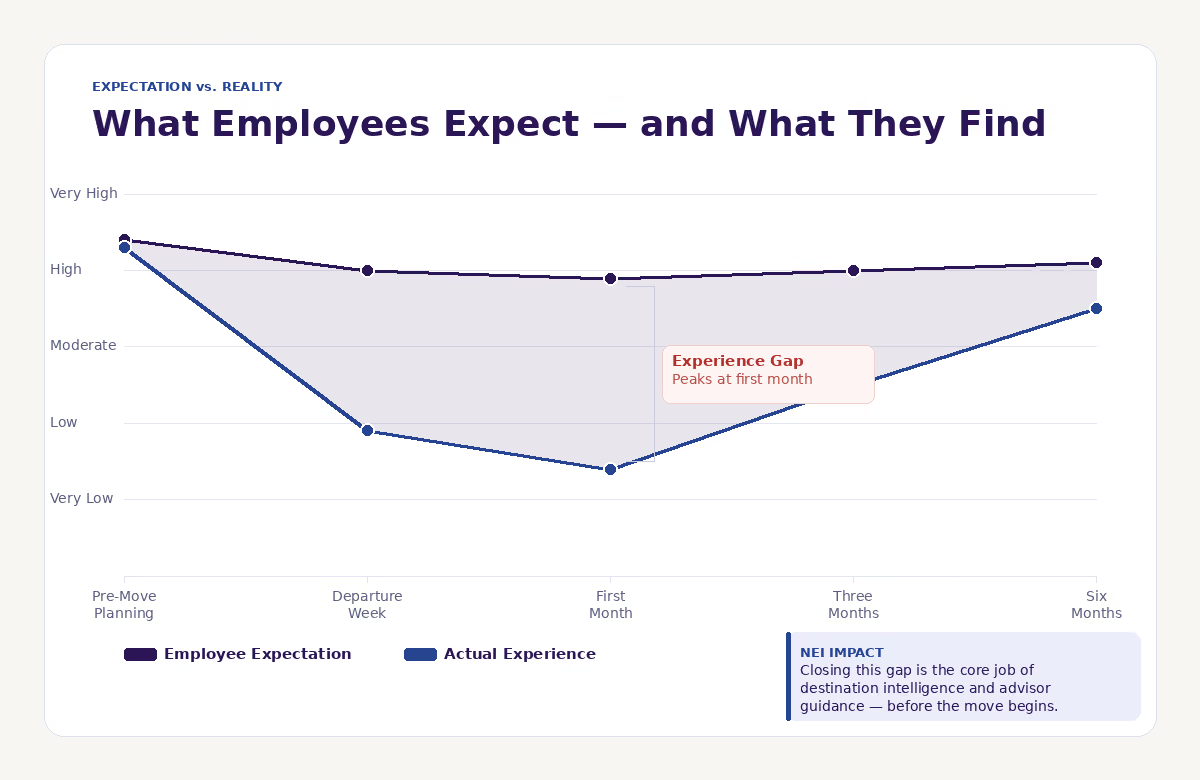
How NEI Helps
NEI helps control this lever by combining destination intelligence, experienced mobility advisors, and a global partner network that can surface local realities early. Employees gain a clearer understanding of what to expect before the move begins, which reduces hesitation and prevents surprises that often lead to policy exceptions or relocation dissatisfaction.
02 of 05
Expectation Setting
One of the biggest drivers of relocation stress is uncertainty. Employees often begin the process with incomplete assumptions about housing timelines, cost of living differences, or how long it will realistically take to settle into the destination market.
When expectations are misaligned, the relocation experience can quickly feel chaotic—even if the logistics are technically handled well.

How NEI Helps
NEI helps control this lever by combining destination intelligence, experienced mobility advisors, and a global partner network that can surface local realities early. Employees gain a clearer understanding of what to expect before the move begins, which reduces hesitation and prevents surprises that often lead to policy exceptions or relocation dissatisfaction.
03 of 05
Expectation Setting
One of the biggest drivers of relocation stress is uncertainty. Employees often begin the process with incomplete assumptions about housing timelines, cost of living differences, or how long it will realistically take to settle into the destination market.
When expectations are misaligned, the relocation experience can quickly feel chaotic—even if the logistics are technically handled well.
How NEI Helps
NEI helps control this lever by combining destination intelligence, experienced mobility advisors, and a global partner network that can surface local realities early. Employees gain a clearer understanding of what to expect before the move begins, which reduces hesitation and prevents surprises that often lead to policy exceptions or relocation dissatisfaction.
04 of 05
Expectation Setting
One of the biggest drivers of relocation stress is uncertainty. Employees often begin the process with incomplete assumptions about housing timelines, cost of living differences, or how long it will realistically take to settle into the destination market.
When expectations are misaligned, the relocation experience can quickly feel chaotic—even if the logistics are technically handled well.
How NEI Helps
NEI helps control this lever by combining destination intelligence, experienced mobility advisors, and a global partner network that can surface local realities early. Employees gain a clearer understanding of what to expect before the move begins, which reduces hesitation and prevents surprises that often lead to policy exceptions or relocation dissatisfaction.
05 of 05
Expectation Setting
One of the biggest drivers of relocation stress is uncertainty. Employees often begin the process with incomplete assumptions about housing timelines, cost of living differences, or how long it will realistically take to settle into the destination market.
When expectations are misaligned, the relocation experience can quickly feel chaotic—even if the logistics are technically handled well.
How NEI Helps
NEI helps control this lever by combining destination intelligence, experienced mobility advisors, and a global partner network that can surface local realities early. Employees gain a clearer understanding of what to expect before the move begins, which reduces hesitation and prevents surprises that often lead to policy exceptions or relocation dissatisfaction.
Why Care About Employee Experience & Talent Success?
Relocation is usually triggered by a business need. If the employee experience around that move is poorly managed, several things begin to happen that carry real business cost.
Technology that provides visibility
NEI's platform gives organizations real-time insight into relocation progress and program performance—so issues are caught before they reach the employee.
Experienced mobility professionals
Mobility specialists guide organizations through complex relocation scenarios—anticipating friction points and coordinating across all stakeholders before problems compound.
A global network of trusted partners
Vetted local specialists capable of delivering reliable destination support—the expertise that determines whether employees feel supported or overwhelmed during the transition.
Why This Outcome Matters
When the Employee Experience Improves, Business Outcomes Follow
When these elements operate together, employee experience becomes something organizations can actively manage rather than react to.
And when the employee experience improves, the business outcomes behind relocation—acceptance rates, productivity ramp-up, and retention—tend to improve alongside it.